 DoorGuard
 How it works
 Plans and pricing
 Try it yourself
 Free Door Health Score
 Garage door guides
 Questions and answers
 Service areas
 Book a visit
 Property managers
 Agents and inspectors
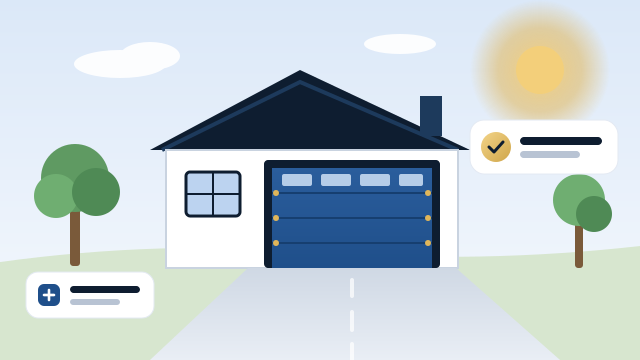
What 25% off the labor looks like
Example only, using $250 of labor. Your costs may differ. The membership does not pay for repairs; members pay 25% less on the labor. Plans from $19 a month.
See the plansA garage door is one big panel facing the outdoors. If your garage is attached to the house, sits under a bedroom, or doubles as a workshop or gym, how that door handles heat and cold affects how comfortable those spaces feel.
Insulation can help. It's worth knowing what it does well and where it has limits, so you put your effort in the right place.
What insulation does
- Slows heat moving through the door. It keeps summer heat out longer and holds some winter warmth in.
- Helps the rooms next to the garage. A room over or beside an attached garage feels the difference when the garage stays closer to indoor temperature.
- Makes the door quieter. Insulated doors tend to rattle and echo less.
- Adds stiffness. Doors with insulation sandwiched between steel layers are often more resistant to dents.
What it doesn't do
- It doesn't stop air leaks. If air is flowing under or around the door, insulation in the panels won't stop it.
- It doesn't heat or cool the garage. It slows heat moving through the door, but walls, windows, the ceiling and any attic space over the garage matter too.
- It doesn't change much for a detached garage you rarely spend time in.
Seal the gaps first
Before thinking about insulation, check the edges. Air moving under and around the door can undo much of what insulation does.
A cracked or flattened bottom seal and worn weatherstripping on the sides and top are the usual sources, and our guides to each show how to check them. If the goal is a comfortable house, the seal on the door between the garage and the house matters too. Fixing seals is often the simplest first step.
Not sure how your door is doing? Answer 7 quick questions and get a 0 to 100 score with an A to F grade in about 60 seconds. No email needed. Take the free checkup.
How steel garage doors are built
Steel garage doors come in a few basic builds.
- Single layer. A steel skin with no insulation. The lightest and simplest.
- Double layer. Steel on the outside with insulation backing on the inside.
- Triple layer. Insulation sandwiched between an outer and inner steel skin. Usually the sturdiest and quietest.
You'll see insulation described with an R-value. It's a measure of how well the material resists heat flow, and higher means more resistance. Makers don't all measure it the same way, so compare doors from the same maker when you can, and ask a professional what makes sense for your climate and how you use the garage.
Add-on insulation kits and weight
Insulation kits that attach to the inside of an existing door are easy to find. They can help, but there's a catch. Every piece you add makes the door heavier, and the springs are set for the weight of the door as it was.
A door heavier than its springs are set for is out of balance. It feels heavier to lift by hand, may drift down when let go, and makes the opener strain on every trip. Over time that wears the opener and other parts faster. Our guide to signs your door is out of balance explains how to spot it.
- Ask first. Before adding a kit, ask a professional whether your springs can handle the extra weight.
- Have the balance checked after. Don't adjust the springs yourself to make up for it.
- Keep panels clear of moving parts. Kit panels shouldn't block hinges, rollers or the joints where sections bend over the curve of the track.
- Test the safety features. Run the sensor and auto-reverse test afterward.
A few more comfort tips
- Keep the door closed when you're not using it, especially on very hot or cold days.
- Check the bottom seal each season as the weather changes.
- Have the opener checked after big changes. A heavier door can need its opener settings reviewed. That's a job for a professional, not something to turn up yourself.
The bottom line
Insulation is a comfort upgrade, most useful for attached garages and spaces you spend time in. Seal the gaps first, choose insulation that fits the way you use the garage, and treat any change to the door's weight as a reason to have the balance checked. A yearly tune-up includes a balance test and an opener safety test, so it's a good time to bring up any changes you've made.
DoorGuard membership starts at $19 a month. Every plan includes a yearly tune-up and safety inspection, priority scheduling if something goes wrong, and 25% off repair labor, with the price shown before any work begins. No contract, cancel anytime. See membership plans.